



New York & Tri-State CRE News In Your Inbox.
Sign up for Connect emails to stay informed with CRE stories that are 150 words or less.


Industry Leaders “Bullish” on the Future of NYC Multifamily
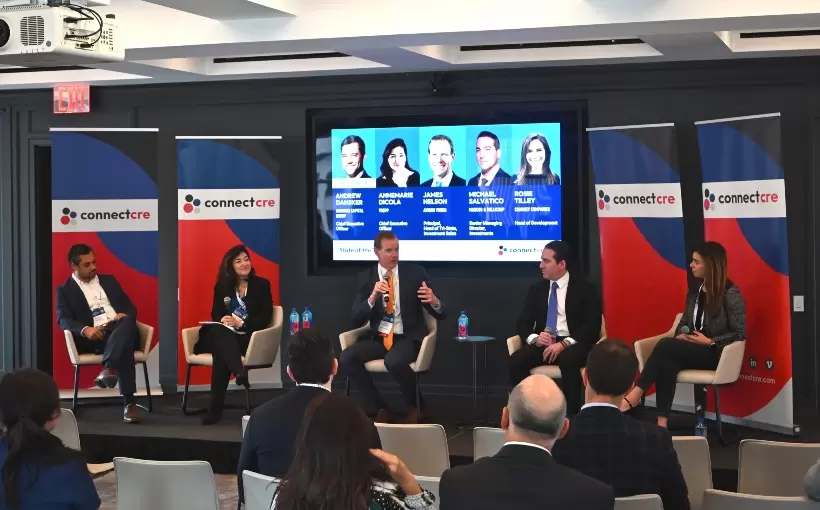
“I am super bullish for the first time in two years that things are really going to open up,” said Avison Young’s James Nelson during the “State of the Tri-State” panel at the well-attended Connect Tri-State Multifamily 2024 in-person event, held Oct. 1 at Rockefeller Center’s Studio Gather. That newfound bullishness followed a two-year period in which New York City investment sales volume annually has been “a third of the 10-year average.”
A key factor in bringing the sales market to a crawl was the onset of the Federal Reserve’s “unprecedented” series of increases in the federal funds rate, said Nelson, head of Tri-State investment sales at Avison Young. “Not only was there downward pressure on pricing, but the real issue was that buyers and sellers alike moved to the sidelines, because uncertainty is never a good thing.”
The Fed’s 50-basis-point rate reduction two weeks ago has begun turning that inertia into stirrings of activity. “It was so significant, not just because of 50 basis points, but what it does to the psychology of the real estate market,” Nelson said.
Even with a renewal of enthusiasm on the part of buyers and sellers, though, a strong motivator for many upcoming transactions will be debt maturities. “There’s $13 billion worth of loans on multifamily properties that will be maturing” in the Tri-State area between now and 2027, said Annemarie DiCola, CEO of Trepp.
She continued, “We have a lot of loans that are going to need new financing. And the issue is that we have very low in-place interest rates. So something like 80% of the maturing loans have in place-interest rates of 1.6%.”
Those impending maturities haven’t led to a wave of REO sales as yet. “The banks right now are being very flexible and they’re trying to make the deal work,” said Michael Salvatico, senior managing director, investments with Marcus & Millichap. “They realize that they don’t want to own it; they don’t want to operate it.”
Among the national stories in the 2024 multifamily market been slower rent growth, and the Tri-State area hasn’t been immune. Salvatico said that in terms of rent growth, “There’s softening right now, but if we look at next summer, I think rents will be right back at peak, just because the supply was suppressed.”
That development drought has occurred at a time when New York City is facing a housing shortage. Nelson said City Hall has cited a need for 500,000 housing units to meet demand, while the Real Estate Board of New York puts that figure at 530,000. Although he acknowledged that “some of you may be sick of talking about office-to-resi conversion,” it could represent a partial solution, especially in a city with so much office stock.
The state’s 421-a tax abatement for residential development expired in June 2022, and both the Adams administration and the state government have sought to fill the breach. Mayor Eric Adams’ multi-pronged City of Yes proposal drew an enthusiastic response from panelists.
“We’re really excited about City of Yes,” said Rosie Tilley, director of development at Charney Companies. “There needs to be so much focus on increasing supply. And in New York, there’s been so much enthusiasm for creating a little bit of housing in every neighborhood. I think that’s a great tagline and approach.”
As for the state’s recently enacted 485-x tax incentive, intended to promote housing development but with potentially expensive implications, “I think everyone is still trying to figure out what that means for costs,” Tilley said. “All we know is that it’s not good.” She predicted a wave of 99-unit buildings—i.e. just below the 100-unit threshold of 485-x.
The discussion concluded on an optimistic note, with Nelson noting that Gucci, Prada and Hyundai have paid hundreds of millions of dollars this year to buy their office buildings outright. “These companies are showing that they want to be here,” he said. DiCola pointed out that New York City is the exception to the scenario of remote/hybrid workers no longer willing to pay rents to be in the cities where their offices are located.
Andrew Dansker, CEO of Dansker Capital, moderated the “State of Tri-State” discussion. Look for additional coverage of Connect Tri-State Multifamily 2024 in the next few days.
- ◦Sale/Acquisition
- ◦Development
- ◦Financing
- ◦Economy
- ◦Policy/Gov't


