


National CRE News In Your Inbox.
Sign up for Connect emails to stay informed with CRE stories that are 150 words or less.


Not All Inflation is Created Equal
Wall Street and the Federal Reserve pay close attention to inflation numbers, including the Consumer Price Index (Bureau of Labor Statistics) and the Personal Consumption Expenditures Price Index (Bureau of Economic Analysis).
Just-released CPI numbers indicating a 0.2% rise in the annual inflation rate have prompted many analysts to wonder how much the Federal Reserve will cut the Effective Federal Fund Rate (EFFR) when it meets next week.
However, a recent brief prepared by CBRE explains that what the CPI shows is only part of the story. The CPI is a national rate, and “it’s important to note that inflation can differ from one area to another,” according to the brief.
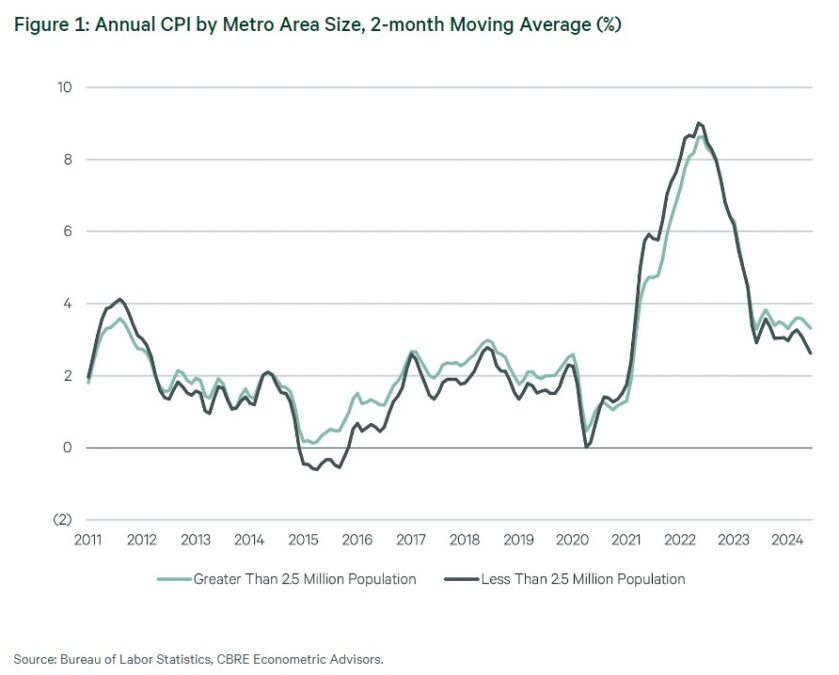
To back this assertion, CBRE analysts tracked changes in the consumer price index for metro areas of different sizes. The results demonstrated that smaller cities experienced deflation in 2015, “a time when both oil & gas and manufacturing—industries that are prominent in smaller cities—were weak,” the brief said. On the other hand, larger cities with service and information jobs and industries were less affected at this time.
Fast-forwarding five years later, the brief explained that prices in smaller cities saw a run-up, likely due to the COVID-era flight away from larger urban centers. “Many smaller cities also lifted public health restrictions more quickly than did large urban centers, allowing the revival of commerce to push up prices more quickly,” the brief said.
These days, consumer prices “are falling slightly faster in smaller cities.” The brief explains that housing costs, which comprise the most significant component of the CPI, have been higher in the larger cities.
- ◦Economy
- ◦Policy/Gov't


