



National CRE News In Your Inbox.
Sign up for Connect emails to stay informed with CRE stories that are 150 words or less.

Can Heat Pumps Work with Commercial Properties?
While heat pumps are considered energy efficient for single-family homes, plenty of obstacles stand in the way of their use for commercial real estate.
The Urban Land Institute, the ULI Randall Lewis Center for Sustainability in Real Estate and the American Society of Heating, Refrigerating and Air Conditioning Engineers (ASHRAE) joined forces to debunk the myths standing in the way of heat pumps and their use in commercial real estate properties.
The resulting report, “Pumping Up Sustainability,” introduced some current myths (and myth-busting responses) connected with heat pumps.
Myth: Heat Pumps are Not Cost-Effective
The reality is that heat pumps are at least three times more efficient than traditional heating and cooling, according to the report’s authors. Certainly, equipment and installation might carry higher up-front costs, but owners can anticipate long-term cost savings on the back end. This is the case in new construction projects containing tight building envelopes and energy-efficient finishes. In these situations, “heat pumps will lead to lower utility bills in both offices and multifamily buildings,” the report said.
Myth: Heat Pumps Are Too New for Commercial Viability
In truth, heat pump technology has been around for decades and is in widespread use throughout Asia Pacific and Europe. The report noted that 90% of households in Japan (where the stock is mainly multifamily) rely on heat pumps for heating and cooling. Meanwhile, in Norway, most buildings are powered by heat pumps, which were introduced there in the 1970s.
Myth: Heat Pumps are Useful Only in Single-Family Homes
Many different types of heat pumps are available for various building needs. Ducted and ductless pumps tap into various energy sources (including air, water or ground). The report explained that mini-split or split systems “are strong candidates for mid-rise buildings with smaller floorplans.” Meanwhile, Variable Refrigerant Flow (VRF) pumps can be ideal for larger buildings, though they can come with a higher upfront cost and risks of refrigerant leakage. “The application and size of the project are important determinants in assessing which product to use,” the report said.
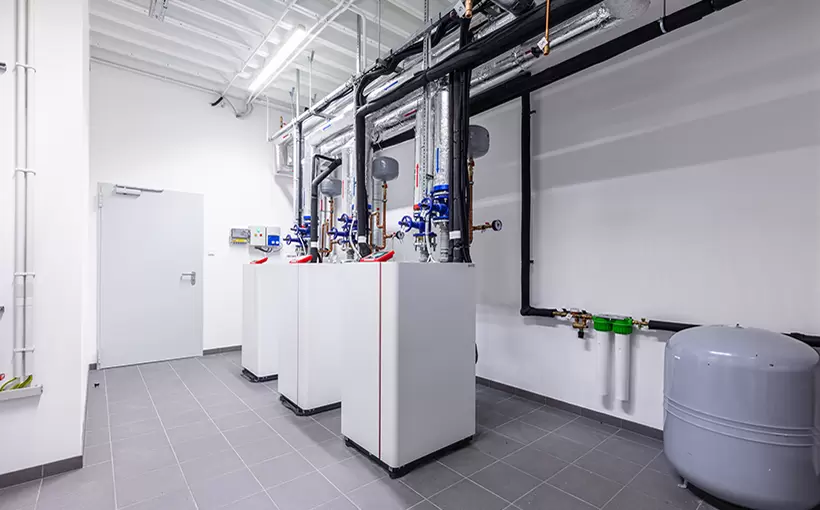
Myth: Heat Pumps are Loud, and They Take Up Space First, the noise made by an air-source heat pump is similar to that produced by a household refrigerator. Additionally, multiple heat pump sizes and configurations are available. These range from mini-split systems (installed in the outside wall) to a VFR set-up, which typically sits on rooftops. “Depending on the type of project, heat pumps could be stored in, on top of, or adjacent to the building,” the report said.
- ◦Development


