



National CRE News In Your Inbox.
Sign up for Connect emails to stay informed with CRE stories that are 150 words or less.

Supply Chain Disruptions: Still With Us
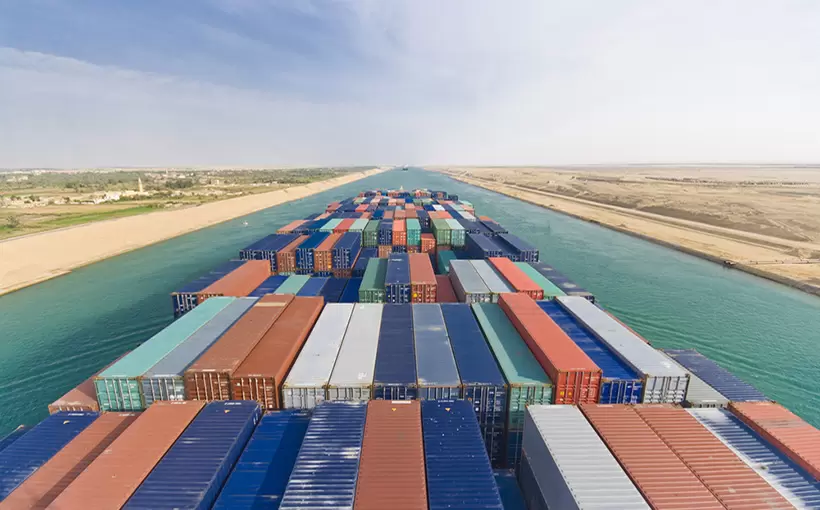
Just when it seemed safe to breathe a sigh of relief about post-pandemic supply chain disruptions, the situation occurred again. The culprit this time is Houthi rebels from Yemen, who attacked ships in the Red Sea in December 2023. While the Houthi danger has been drastically reduced, shipping companies continue to avoid sending their cargo through the Suez Canal.
According to a JLL report, about 12% of global trade and 30% of the world’s containers pass through the Suez Canal. Shippers either keep goods in safe locations or take longer routes out of an abundance of caution. According to the International Monetary Fund, shipping on the Suez Canal dropped by 20% year over year.
The result? “Long delays and higher costs are quickly becoming commonplace,” said Lisa Graham, JLL’s director of EMEA Industrial & Logistics Research & Strategy, in the report. Another result? “As goods face delays, companies are reviewing their inventory management strategies even further,” Graham added.
Blockages in the Suez Canal aren’t new. In 2021, a stuck container ship blocked this key trade route for six days. But these delays, combined with supply chain disruptions following the COVID-19 shutdowns, are prompting companies to understand that “over-reliance on one route, region or country is unwise,” Graham commented. While the Suez Canal situation mainly impacts European trade, U.S. companies could also benefit from a shift in logistics strategies like the following:
Shifting inventory management systems. Graham pointed out that moving from a just-in-time to just-in-case inventory management systems can help diversify inventory locations. “Reducing reliance on a factory or suppliers in one region, through reshoring a portion of the former and expanding the latter to, or close to, Europe, is becoming a strategy of choice,” she added.
Fragmentation with trade partners. This involves incorporating only aligned trade partners into supply chains. “If fragmentation gains steam in Europe, whose economies rely heavily on intra-regional trade, then reshoring and near-shoring of production and suppliers is likely to accelerate,” Graham pointed out.
Graham acknowledged that such changes could take time and are costly. She added that the impact of reduced Suez Canal shipping on supply chains should be temporary, mainly due to weakened consumption for goods in Europe.
Still, “unexpected events disrupting supply chains continue to emphasize the need for both robust contingency plans and flexibility in logistics operations,” she said.
There’s still time to register for the Connect Industrial Midwest 2024 event on March 5 at Joe’s Live in Rosemont, Illinois. Click here for more information and to register.

