



National CRE News In Your Inbox.
Sign up for Connect emails to stay informed with CRE stories that are 150 words or less.


Expect Continued Conflict over Remote Work
When the pandemic led to “stay at home” orders in 2020, many office employees who could did just that. They stayed at home and worked remotely.
Today, COVID-19 (along with the current influenza strain coupled with the respiratory syncytial virus or RSV) makes remote work compelling on the employee side. Not so much for bosses, however. A recent article in The Economist penned by business affairs editor Rachana Shanbhogue explained that employees work, on average, a day and a half a week from home and would like to see that doubled. On the other hand, “Everyone from Goldman Sachs to Zoom is asking its reluctant workers to show up to the office more often,” Shanbhogue said.
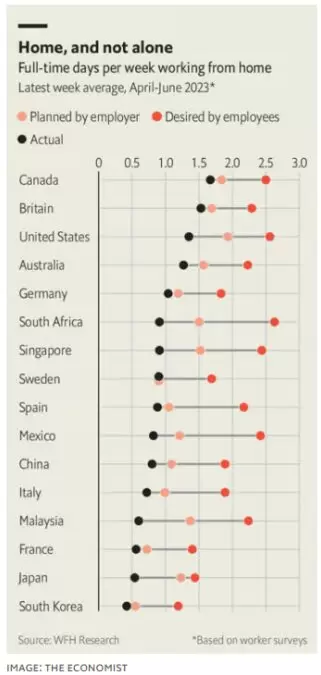
Shanbhogue pointed out that the five-day-a-week schedule is in the past, with “the most likely outcome is that bosses and workers meet in the middle.” This could mean less remote work.
But this also depends on the economy. If the higher interest rates slow down economic growth, unemployment could increase. If “workers are no longer in short supply, bosses will drive a harder bargain,” Shanbhogue explained.
Interestingly enough, despite the cries of increasing office space vacancies that made headlines in 2023, the truth is that the remote work shift has “had a curiously muted effect on the commercial property industry,” partly due to long-term leases. But that could change in 2024.
In quoting metrics from Goldman Sachs, Shanbhogue noted the following:
- 12% of office leases will be up for renewal in 2024, more than twice as many in 2023
- Remote working could mean that 46 million square feet of office space will be vacant in the United States – “equivalent to all the floor space built in 2022”
- Office buildings that comply with tightening environmental standards will be in high demand; older office structures not so much
Shanbhogue explained that COVID-19 led to “the biggest shift in professional life for decades,” with “the consequences still working their way through corporate hierarchies and the financial system.” While the pandemic might be over, remote work will continue influencing “how and where people work and play,” Shanbhogue wrote.
- ◦Lease
- ◦People
- ◦Economy

