



National CRE News In Your Inbox.
Sign up for Connect emails to stay informed with CRE stories that are 150 words or less.


The Expansion of the CRE Auction Process
As recently as a decade ago, online commercial real estate auction platforms were primarily used by banks and special servicers to dispose of distressed assets efficiently. Those days, however, are firmly in the past, thanks to the growing adoption of technological innovation and a proven track record of successful transaction results for sellers and buyers alike.
The ability for buyers to easily access due diligence materials to efficiently underwrite and securely bid on a level playing field, coupled with an expedited transaction timeline with non-contingent bids, has positioned online auctions as an efficient, viable approach to buying and selling non-distressed real estate assets.
The decision to use an auction platform is based on a seller’s objectives. The strategy is best for owners with a compelling reason to sell, said Jim Palmer, a Marcus & Millichap Senior Vice President and National Director of the firm’s dedicated Auction Services division. “It could be the result of a death or divorce, the dissolution of a partnership or fund, maturing debt—all potential reasons an investor would need an expedited transaction timeline with certainty of close,” he said.
An Auction Explanation
Most CRE auctions are Reserve Auctions with an undisclosed minimum price at which the owner is obligated to sell. While the highest and best pricing is usually not the primary driver for the seller, it’s possible to achieve retail pricing for a quality asset that attracts multiple qualified bidders. The key to this is establishing the right reserve price.
“It’s important to note that this is not what we believe the property is valued at or where we anticipate bidding to end,” Palmer explained. “Rather, it’s about a number that we feel confident will bring in multiple qualified buyers to compete and hopefully create a bidding war.”
The competition can intensify once the reserve price is met and buyers realize the asset will trade. Once competitive juices get flowing, few buyers will risk losing the deal over $25,000 or $50,000.
“An auction provides true price discovery,” Palmer said. “The key to achieving that is to have a seller that’s realistic on pricing and trusts us to create a market with competitive, organic bidders that will push pricing above the reserve. We’re simply establishing a floor and allowing the market to compete.”
For example, Marcus & Millichap’s Commercial Property Auctions Division averages 23% above reserve price.
How it Works
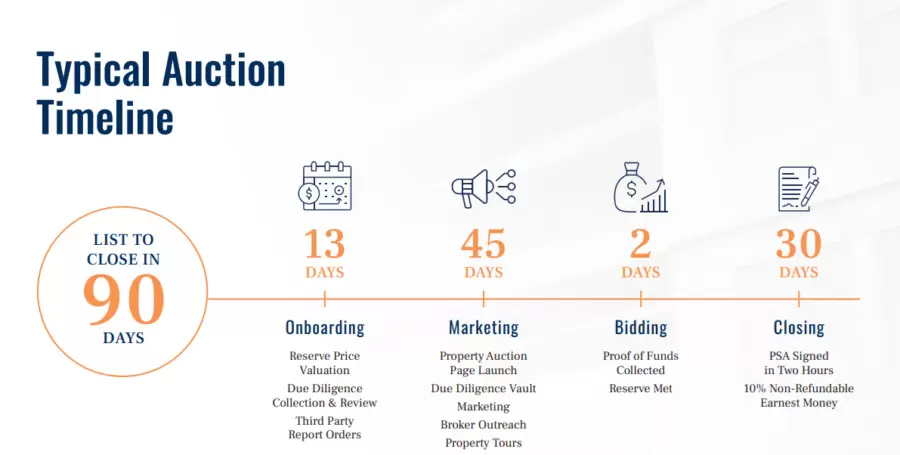
The Marcus & Millichap brokerage team works with sellers to collect up-to-date and comprehensive due diligence packages, including financials, rent rolls, property condition reports, title reports, and other third-party documents. This is uploaded to a due diligence vault that potential bidders can access on the auction platform.
Sellers can follow the deal’s progression in real-time via the backend dashboard to see how many people have signed a confidentiality agreement, accessed the due diligence vault, the number of approved bidders and their buyer profiles. This transparency helps give sellers confidence that the deal is indeed being exposed to all possible buyers.
Meanwhile, all approved bidders must upload proof of funds. Buyers often range from private capital investors owner users to prominent institutional players. Auctions also require buyers to perform their due diligence on the front end during the 45-day marketing period. All bids are non-contingent; the winning bidder must execute the PSA within two hours and wire a 10% earnest money deposit within 24 hours, which goes hard, followed by a 30- to 45-day close.
The outcome is based solely on the highest bid at the end of the auction, not on reputation, relationships or any other factor that might influence a traditional sale. “It’s a democratized process based simply on who is willing to pay the most,” Palmer said. “Interestingly, we often see buyers return to us wanting to sell their properties because they like the process.”
But roughly one in 10 assets don’t even make it to auction, Palmer said. This was the case with two Chicago office properties the auction division recently sold. “The buyer submitted a pre-auction offer because he didn’t want to compete and potentially lose in the auction,” Palmer said. “It was a known local buyer that had expressed interest in the assets before our auction marketing campaign.” Still, the assets traded for almost $1 million more than the reserve price, and the auction terms still applied to the sale.
The Benefits
Auctions broaden and diversify the potential buyer pool. They also present a level playing field for buyers to compete.
Joel J. Gorgian is a seasoned commercial real estate investor and longtime client of Marcus & Millichap’s auctions team. Having been on both the buy and sell side for the past eight years, he’s grown quite familiar with the process—and the results.
Disposing an asset at auction generates a final sale price that’s on par with what could be achieved on the traditional market, said Gorgian, a principal with Gorjian Acquisitions, a New York-based national investor specializing in opportunistic value-add properties. “Not only can you realize the same results, but there’s also the advantage of having the buyer perform on a non-contingent, non-negotiable contract,” he said. “To be honest, it’s a total no-brainer.”
In addition to price discovery, sellers like the streamlined, expedited process. While traditional listings can often take 6 to 12 months to close, an auction takes an average of 90 days from list to close.
Auctions also provide certainty of close, something that’s proving to be invaluable nowadays, where a myriad of dynamics can cause a transaction to unravel. Gorjian said that assurance is the most significant value-add that auctions can provide. “I can’t tell you how many times buyers have tied deals up with me to re-trade or completely walk away when their due diligence period expires,” he commented.
Gorjian isn’t alone in this observation. “We’re getting a lot more calls from sellers with the increased number of deals being re-traded and falling out of escrow,” Palmer explained. “With rates continuing to rise, uncertainty in the market and a wide bid-ask spread, sellers are looking for ways to increase their certainty and mitigate risk in the deal.”
Auctions can encourage previously interested yet hesitant parties to step up and execute. An auction tends to instill a sense of urgency and fear of loss in the buyer pool, many of whom were unwilling to perform pre-auction as they viewed time to be on their side.
The Growth of the Auction Space
As the only major commercial real estate services firm with a dedicated auction division, Palmer said Marcus & Millichap is bullish on the transaction volume growth within his division.
“With both buyers and sellers increasingly adopting auction as a disposition and acquisition strategy within their portfolios, we’re investing in what we anticipate will be a larger market opportunity,” he said. “The ability to leverage a team of experienced auction advisors with the highest execution track record in the industry, as well as combine our database of auction clients with the firm’s broader platform of buyers and sellers, allows us to broaden the suite of services we can offer our clients.”
- ◦Sale/Acquisition
