



National CRE News In Your Inbox.
Sign up for Connect emails to stay informed with CRE stories that are 150 words or less.

Employee Data and Back-to-Work Numbers

With the pandemic in the rearview mirror, return-to-office mandates are on the rise. Having said that, many workplaces don’t ask their employees to show up every day from nine to five. In the post-pandemic work world, many workers come into work anywhere from two to four days a week.
Placer.ai noted that the “new hybrid status quo is already presenting cities, Business Improvement Districts, retailers, dining concepts, commercial real estate firms and other stakeholders with significant challenges.”
Additionally, while there has certainly been an increase in office visits since initial closures, “that recovery has plateaued in recent months, indicating that the rise of virtual work has had an impact on a significant portion of the workforce,” Placer.ai’s Senior Vice President of Marketing Ethan Chernofsky, told Connect CRE.
To better understand worker visitation patterns, Placer.ai collected employee data from Boston, MA; Chicago, IL; Houston, TX; New York, NY and San Francisco, CA to “explore the preferences, behaviors and profiles of on-site workers in the workplace-heavy downtown areas . . .”
That data ended up showcased in a white paper entitled “Exploring the On-Site Workforce in 5 Major U.S. Cities.”
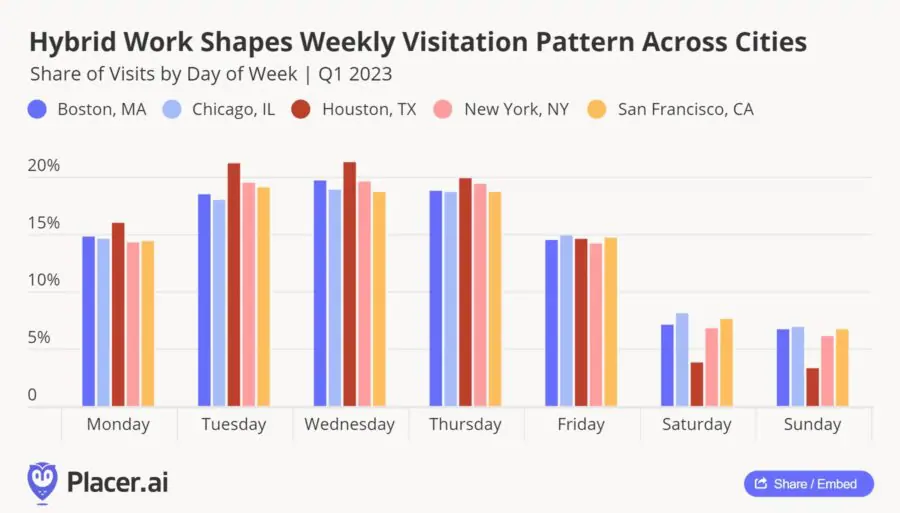
Here’s what some of the data indicated:
- Employee traffic to the five downtown areas was heavier during the middle of the week; Fridays and Mondays showed the lowest share of visits.
- Top executives account for a disproportionate share of employee visits – demonstrating that these executives are attempting to lead by example.
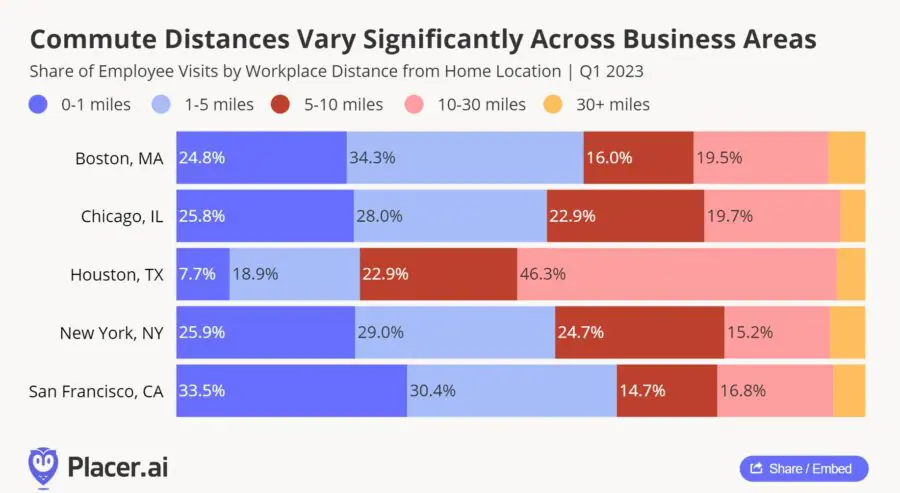
- Proximity to the workplace determines visit frequency. In Boston, Chicago and New York, close to one-quarter of employee visits came from areas less than a mile away from the main business center.
- Houstonians, unsurprisingly, depend on their cars. In the other cities, not so much. The larger cities with public transportation end up making short treks to work. For those in Houston, adequate parking space is a must.
- One-person households had the disproportionate share of employee visits.
Other takeaways from the report included that workplace visitation patterns vary across professional sectors and that ease of access is important.
Chernofsky noted that employers are focusing on how to make the office place more appealing to employees. “From amenities within the building to the experience in the immediate surroundings, there is a push to help offset some of the impact of virtual work,” he said.
Placer.ai analysts noted that office visitation information is important for other stakeholders as well. “The ripple effects of lower workplace attendance are impacting everything from neighborhood food trucks, to stores, hotels and subway systems,” they noted in the white paper.
- ◦Lease
- ◦People
- ◦Economy
- ◦Policy/Gov't


