



National CRE News In Your Inbox.
Sign up for Connect emails to stay informed with CRE stories that are 150 words or less.



Report: Mortgage Fraud Risk Down, But Could Increase
CoreLogic’s Q2 2022 National Mortgage Application Fraud Risk Index was 121, representing a 13.5% quarterly decline and a year-over-year fall of 7.5%. While this might seem to be good news, CoreLogic reported that:
- Some of the index’s decline can be attributed to its updated scoring model
- Analysts noted increasing risk levels of fraud in the months ahead
The Index represents a share of loan applications that support a high risk of fraud.
Mortgage application activity increased from 53% in Q1 2022 to 71% in the second quarter, while application volume continued to decline, but less dramatically than in previous quarters. Part of the reason for fluctuations in mortgage applications is due to the Federal Reserve’s continued increase in the Effective Federal Funds Rate (EFFR). This means it can be more difficult for prospective homebuyers to obtain a mortgage loan.
“Fraudsters thrive in uncertain market conditions, where their activities are harder to detect and separate from legitimate investors who are also attracted to variable markets,” Ann Regan, CoreLogic’s Executive, Project Management, told DS News. She added that if a forecasted recession becomes reality in late 2022, early 2023, “we can expect to see market variability in other regions and likely an increase in fraud as well.”
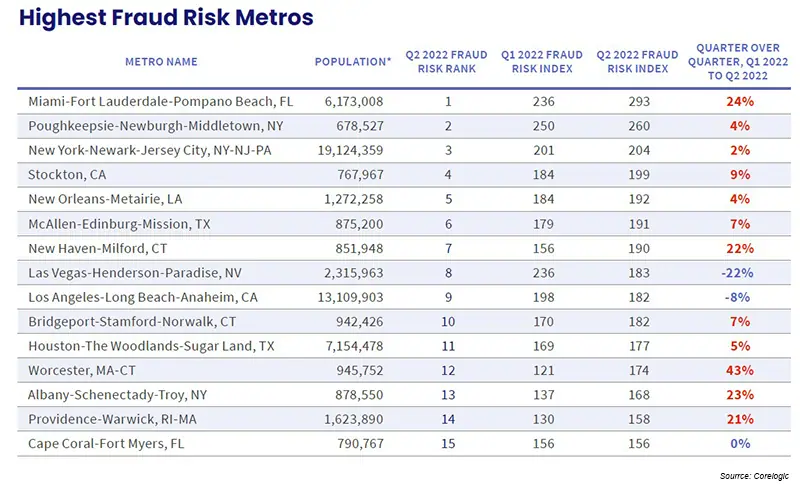
DS News also reported that an increased ability to work remotely is driving the population to areas experiencing incidences of high mortgage fraud, including Miami, FL and the Poughkeepsie-Newburgh-Middletown, NY Metropolitan Statistical Area (MSA). CoreLogic ranked these area one and two respectively as likely to have a higher risk of fraud.
Mortgage fraud is defined as deliberately lying or omitting information that an underwriter or lender uses to issue mortgage loans. Such fraud can be committed by borrowers and lenders. Bank officers, appraisers and mortgage bankers tend to commit fraud for profit, while borrowers are more likely to commit fraud for property.
- ◦Financing
- ◦Economy
- ◦Policy/Gov't


