



Seattle & Northwest CRE News In Your Inbox.
Sign up for Connect emails to stay informed with CRE stories that are 150 words or less.

How Can Buildings Drive Carbon from the Environment?
The U.S. Department of Energy estimates that in the next two decades, national adoption of grid-interactive efficient buildings (GEBs) could be worth between $100 to 200 billion in U.S. electric power system cost savings. By reducing and shifting the timing of electricity consumption, GEBs could decrease greenhouse gas emissions by 80 million metric tons per year by 2030, the equivalent of more than 200 million miles driven by the average passenger vehicle.
Energy startup Edo recently launched, with the goal of getting buildings and utilities to collaborate on these buildings. Edo combines technical tools and support services into one ecosystem that builds new revenue streams for utilities, building owners/operators, and architecture, engineering and construction (AEC) firms.
“We wake up every day thinking about what needs to be done to unlock the promise of GEBs,” said Hendrik Van Hemert, managing director of Edo. “We’re reimagining the way buildings can participate in the grid to drive carbon out of the built environment and the grid in a way that’s equitable for everyone.”
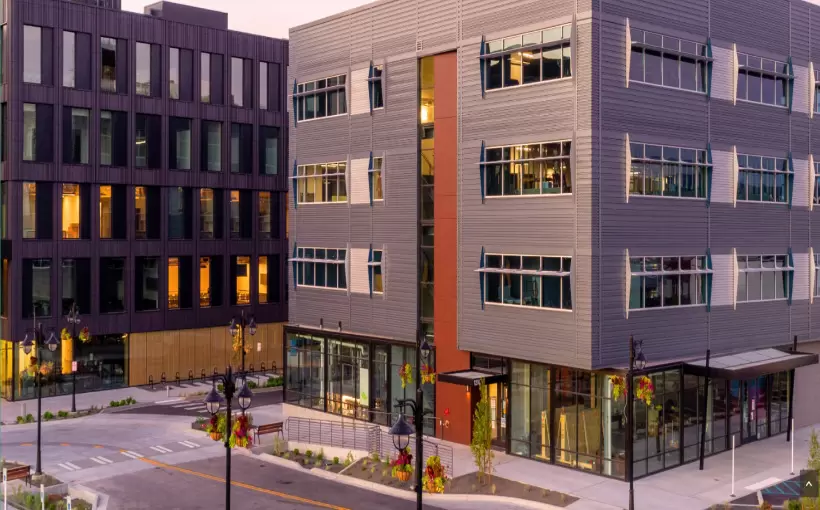
Among Edo’s first successful projects is the South Landing EcoDistrict in Spokane, WA. The project includes the Catalyst building, one of the largest and most innovative zero-carbon and zero-energy buildings in North America, and the Scott Morris Center for Energy Innovation. The EcoDistrict breaks through the traditional utility-customer (meter) and landlord-tenant (lease) barriers. Edo aggregates and controls the entire campus electric consumption and balances it against the needs of both the development and the grid.
- ◦Development

