



National CRE News In Your Inbox.
Sign up for Connect emails to stay informed with CRE stories that are 150 words or less.
What’s Driving the Future of Healthcare Buildings?
Transwestern’s new report, The Future of Healthcare Buildings, surveyed 21 thought leaders from healthcare-related organizations across the U.S. and asked them to share their insights regarding the future of healthcare and healthcare delivery. Participants in the survey represented healthcare systems, academic medical campuses and providers as well as commercial real estate, architecture, engineering and construction firms.
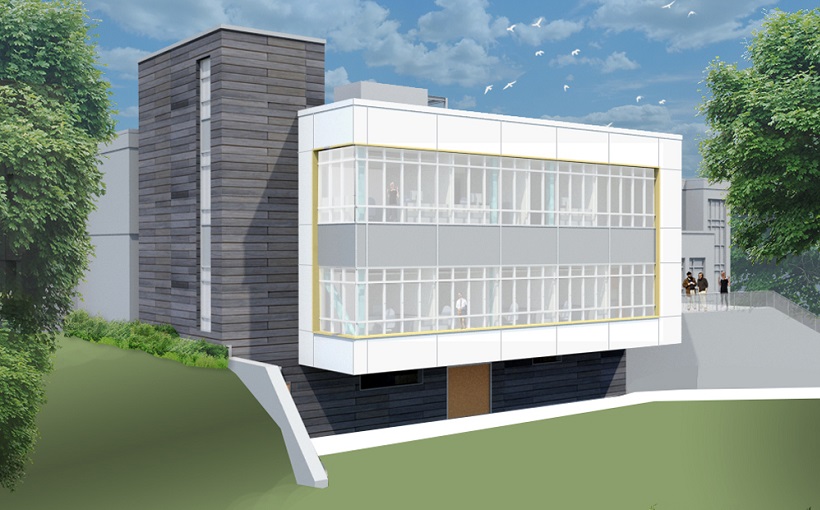
(Pictured above: Center for Neurorestoration and Neurotechnology Research in Providence, R.I.)
Four dominant themes emerged from the Transwestern report:
- Data, data and more data—With the rapid integration of wearables, virtual health and artificial intelligence, we will all have more data to interpret and use.
The U.S. population already generates 2.5 quintillion bytes of data per day. Accenture estimates the artificial intelligence (AI) health market will grow to $6.6 billion by 2021, and key clinical health AI applications could save the U.S. healthcare economy $150 billion annually by 2026.
Artificial intelligence is being adopted more readily because we are starting to see a full ecosystem around it. While hospitals have always focused on patients, the spotlight is now on the patient experience and its effect on outcomes.
Respondents say virtual health is coming, but adoption will be slow until U.S. policies “reimburse” and “motivate” hospitals for its use. We think faster implementation is preferable. The bottom line is that technology disruptions will continue – the question is, how quickly?
Mike Zorich, principal of IMEG Engineering, says the collection, analysis and use of data by healthcare organizations has grown and will continue to grow as we move forward. The company has identified improvements, and invested in how it effectively utilizes the data it has collected on projects over the years, and more important, how it will collect and utilize data moving forward.
“The more information we can provide to our healthcare clients about a specific building type, location, specific infrastructure systems, operational costs, efficiencies, etc.,” Zorich says, “the more it will help them make informed and cost-effective decisions earlier in the design process, saving the team time and money, resulting in positive impacts for the patients and staff within new and renovated facilities as they are brought on line.”
- Technology—Whether it is equipment, radio-frequency identification (RFID), wearables or apps that help us do more with less, we must keep up with technology. Virtual health will play an increasingly-significant role in the delivery of healthcare.
Telemedicine is predicted to attract seven million users by end of 2018, and is estimated to grow by 14.3% by end of 2020. An overwhelming 90% of healthcare executives responded that they have recently or soon will be implementing a telemedicine or virtual healthcare program.
“We will see an increase in healthcare facilities that may never see a single patient,” predicts Eric Vandenbroucke, senior principal of IMEG Engineering. These spaces will include facilities to support telemedicine and virtual medicine, remote monitoring of patients, and facilities that are designed to support and maintain vehicles and equipment for mobile outreach care.”
Virtual health also has a positive impact on clinicians and patients, according to Phyllis Goetz, chief strategist of HKS. “In a time where clinician burnout is a concern to our owners, easing workloads and reducing their stress is another positive outcome of virtual health,” she says. “In more rural settings, virtual care is not just a convenience, but provides a connection to caregivers that patients might not otherwise be able to access.”
- Flexibility—The future is fraught with unknowns, and it can take years to construct a new hospital. That’s why our respondents seek greater flexibility in their space, both to accommodate current healthcare delivery and to ease adoption of new approaches in the future.
“Today’s healthcare buildings must accommodate current service delivery, while also making it simple and economical for operators to adapt to new approaches as they are developed,” says Daina Pitzenberger, a senior vice president of Transwestern and secondary author of the report. “This challenge comes as we face a potential shortfall of medical office space, according to our research. Developing a new facility can take up to two years, so designing new facilities to be flexible has never been more important.”
Examples of this flexibility include exam rooms, physician offices, consult rooms and procedure suites which are all built off of the same base dimensions, so that exam rooms may be expanded or contracted or re-purposed without any disruption to the clinic. Additionally, sufficient base building power is brought in, as well as vertical risers design and constructed to accommodate increased fiber runs for the increased demand for internet speed and capacity soon-to-be required by users.
“Our team at Transwestern is building flexibility into the physical buildings which allows for changes in staffing due to AI, virtual healthcare, and the change around in office patient volume and space utilization,” noted Justin Brasell, an executive vice president with Transwestern.
- Decentralization—The move to smaller facilities will continue, along with incorporation of more services. The medical offices and clinics of the future will be smarter buildings.
Patrick Casey, executive director of planning, construction & design at University of Mississippi Medical Center, expects that MOBs of the future will be smaller, with less lobby and waiting space. The total number of examination rooms may be reduced. The healthcare professional will need more time to work both online and virtual. And for the general practitioner, he predicts the facilities will become smaller and leaner in design, with less need for large waiting rooms, and potentially reduce the number of exam rooms.
“We are striving for a seamless experience across channels, virtual and physical,” Casey says, adding that buildings will continue to become smarter and sustainable, with efficiency and the need to reduce cost driving these trends. “As we see continued escalation of construction costs and energy costs, those who build smarter and more sustainable buildings will have a competitive advantage in the future. It will require evaluating the total lifecycle cost of the buildings, rather than the initial capital investment.”
Transwestern’s Pitzenberger says the medical office building of the future will need to be as flexible and energy- efficient as possible. “With the ever-growing need for smart buildings and technology to support patient care and clinician communication, the spaces need infrastructure planning that supports the ever-changing technology and equipment needs,” she explains. “Also, with consumerism driving healthcare service delivery, design teams are challenged to create spaces that positively impact patient satisfaction and outcomes.”
For questions, comments or concerns, please contact Jennifer Duell Popovec


