



New York & Tri-State CRE News In Your Inbox.
Sign up for Connect emails to stay informed with CRE stories that are 150 words or less.

O-Zone Experts: The 10-Year Hold Means Looking at Long-Term Impact
By Paul Bubny
The opportunity zone sector, which didn’t really exist prior to its inclusion in the 2017 Tax Cuts and Jobs Act, has begun generating a healthy level of momentum in terms of projects moving forward. As detailed by speakers at Connect Opportunity Zones 2019, these have taken the form of workforce housing, commercial space, vertical farms in urban areas and mixed-use developments around soccer stadiums, among other uses.
The ultimate impact and community benefit of these and other projects, though, won’t be known until at least the end of the 10-year hold period mandated by the Opportunity Zone legislation and accompanying IRS guidance.
That was among the key takeaways from the experts who shared insights at Connect Conferences’ first-ever Opportunity Zones conference, held Wednesday in Midtown Manhattan.
“It does no good to the community if at the end of 10 years, we sell off everything and they hike up the rents,” said Anthony B. Miles, Qualified Opportunity Zone fund manager for Philadelphia-based TPP Capital Management. A current venture for TPP is a five-square block “Whole Neighborhood Inclusive and Concentrated Health & Wellness Development Project” adjacent to Temple University’s Health Sciences Campus and Temple University Hospital.
Jill Homan, president of Javelin 19 Investments, a Washington, DC-based advisory firm, pointed out that in terms of returns to investors, the bulk of the gains come from that 10-year hold. However, in many projects the focus has been on the four-year stabilization period, rather than on wealth preservation in years five through 10. “So the question is, what do you want to hold for 10 years,” she said.
Like 1031 exchanges, opportunity funds are tax-deferred, said Lance Growth, CEO of Growth 1031. They’re dissimilar, though, in that the hold period is considerably longer—and Growth advised would-be fund managers to give investors clear guidance on when they can expect to start seeing returns.
Buying right is essential, said ODG managing partner Gavriel Kahane. The QOZ program is about benefiting challenged neighborhoods, but also about driving capital out of mature, “dying on the vine” markets and into new areas. He said it’s important that the program “catch like wildfire.”
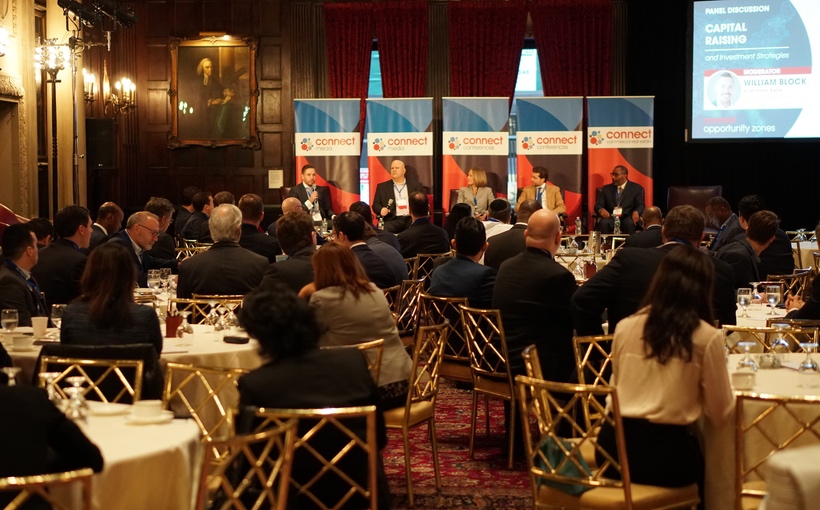
An early criticism of the program has been that for many players, it’s seen mainly as a “tax-avoidance” tactic, said William Block, director of the OZ program at Northern Bank and moderator of the opening “Capital Raising and Investment Strategies” panel. Miles acknowledged that this has meant early QOZ projects have focused on “low-hanging fruit,” and fellow panelist Tony Barkan, CEO of Allagash Opportunity Zone Partners, said the first opportunity funds were basically repeats of what was available outside the program.
“There’s an opportunity for investors to get involved at a much better basis,” said Barkan. He pointed out that working with the communities in which you’re planning to build, rather than going against them with product that might lend itself to neighborhood gentrification, actually reduced the level of risk.
The importance of collaboration with the residents and businesses that will be impacted by OZ projects recurred in the two subsequent panels, “Doing Good: Social Impact Investing and Community Building,” moderated by KPMG partner Ruth Tang; and Alternative Investments Through Opportunity Zones,” moderated by Bracewell partner Brian Teaff.
“Doing Good” panelist Michael Lohr, VP with Goldman Sachs’ Urban Investment Group, observed that there’s a reason that the underserved communities in QOZs have been underserved for so long. That is, no one has taken the time to work with them and understand their needs.
Lohr said that along with measuring the success of OZ projects in terms of jobs or housing units created, it’s important to look at the less tangible benefits. That theme was sounded by RBH Group CEO Ron Beit, whose company has been taking its Teachers Village concept to markets far from its native Newark, NJ. “The quantitative is not enough anymore,” he said. “You need to look at the qualitative” benefits.
Similarly, on the “Alternative Investments” panel, president Zale Tabakman of Local Grown Salads, said that for would-be backers of OZ projects, “one of the things that people care about is, are you talking to the community?”
Naturally, investments are made with the expectation of seeing returns, and Vijar Kohli cautioned that projects that wouldn’t have penciled out pre-OZ probably aren’t going to make sense within the program, either. That being said, Kohli and other “Alternative Investments” speakers said the desire to have a positive social impact is also a motivator.
In particular, Brett Johnson, founder of Fortuitous Partners, said he’s been encouraged by the response from family offices that are interested in getting in on his company’s mixed-use developments around stadiums for United Soccer League franchises. They’re not going to give up their need for returns, he said, but might be willing to scale back their return expectations from double-digit to single-digit in exchange for the chance to make an impact investment.
“There are a lot of thoughtful investors coming in,” said Johnson.
Pictured: The “Capital Raising and Investment Strategies” panel. Moderator William Block (at left) sets the stage for the conversation.
For comments, questions or concerns, please contact Paul Bubny
- ◦Financing
- ◦Development
- ◦Sale/Acquisition

