



Chicago & Midwest CRE News In Your Inbox.
Sign up for Connect emails to stay informed with CRE stories that are 150 words or less.
Growing Tides: Real Estate & Ports
By Dennis Kaiser
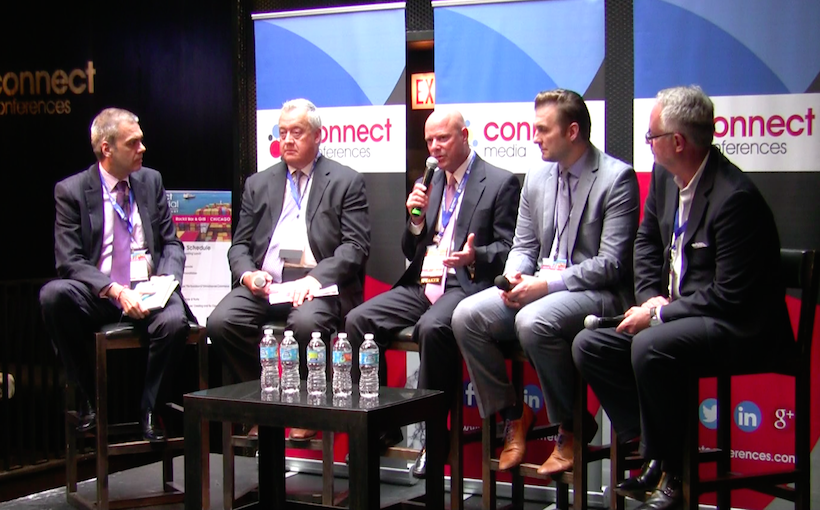
Connect Industrial’s inaugural conference in Chicago on June 28th included a panel discussion on ports and real estate that was moderated by 21CC Education’s Sanjay Tiwari and included BNSF Railway’s Eric Pitcher, Georgia Ports Authority’s John Petrino, Port of Houston Authority’s Shane Williams and the Port of Los Angeles’ Jack Hedge.
The discussion shared insights on how to build bridges from freight handling and cargo side of the business to the CRE investment, development and leasing components. This group of port and logistics industry leaders discussed the landscape of industrial property around the ports, as well as the projected growth of development. Distribution and the supply chain remain critical drivers of industrial real estate, making it vital to have a deeper understanding of the challenges and opportunities on the horizon.
The key takeaways from the conversation included:
21CC Education LLC’s Sanjay Tiwari says logistics is a fickle industry that changes suppliers and customers almost weekly. He advises for the industry to get healthier it will require the “speed dating” period to end with vendors and suppliers. That will lead to a better understanding of what’s being transported inside the containers. In turn, landlords and investors need to do a better job of knowing more about what goes on inside facilities, and how they are being used. It isn’t enough anymore to build a facility, lease it and walk away. Tiwari says, by helping tenants derive more value out of a location it will help them “get a leg up on the competition.” An example of that innovative thinking is Maersk’s trade finance program that funds exports of shippers. It adds value since using its balance sheet to finance their exports can be a cheaper option.
BNSF Railway’s Eric Pitcher says the rail line’s goal is to get distribution facilities as close to a rail line as possible. As rail customers expand their geographic reach, there are more options than ever before that need to be factored in. That makes it important to have facilities in place first, because goods movement decisions are often based on what facilities are available. That requires rail and port operators to forecast demand.
Chicago has seen a dramatic increase in the one-million-square-foot-plus distribution facilities. They are becoming concentrated in certain areas around intermodal rail yards. Intermodal traffic is driving the development of these facilities, and that increase in traffic is particularly noticeable in the domestic market versus the international.
An example is the automotive industry that may ship domestic containers from the Midwest to Mexico with components that get assembled, and then sent back back and forth as the assembly process continues until the final product is built.
The physical needs of facilities are changing for warehouses, too, as elements like auto racking systems are added, which require massive spaces. But, they allow a retailer like IKEA, which is building a 1.5-million-square-foot facility in Joliet, IL, to accommodate a large volume of product in the facility at the same time.
Georgia Ports Authority’s John Petrino says ports are seeking to provide value to customers, and having competing ports around Savannah “helps keep us honest.” That’s because shipping companies and retailers like IKEA, Amazon, Target, etc. will “steer their ships” where the cargo is. Savannah sees 35 ship visits weekly, which is the most on the East Coast. That’s because there are large population centers within four-hour drives, where distribution centers handle goods.
They are seeing more direct ownership by beneficial cargo owners (BCO’s) such as Walmart, as well as long-term (10-year) lease commitments being signed at facilities. Savvy importers are also looking to do deals with strong partners such as shipping lines, terminals and landlords who have strong balance sheets. They have learned what happens when a weak link breaks down. “Hanjin going out of business opened a lot of eyes,” he said. It was a “hard lesson” about how chasing pennies may cost a company dollars.
Port of Houston Authority’s Shane Williams says the Panama Canal expansion “was big for us,” though “it is early in the game to determine the exact impact” of it. The expansion “allowed us to stay in the game. If it wasn’t expanded, it would have taken us out” of the mix for some shippers. An expanding sector for Houston is the new resin facilities, where small plastic pellets are shipped to China and made into plastic bottles or other goods. Since Houston is a base for the petroleum industry, having an expanded Panama Canal should keep that sector moving forward.
Houston is shifting from a time when the norm was facilities in the 40,000-to 80,000-square-foot range. Last year, that shifted to facilities in the 100,000- to 150,000-square-foot range as a typical size. Now the market is seeing even larger facilities. Currently, there are four facilities in the one-million-square-foot range underway.
Port of Los Angeles’ Jack Hedge says the Port of L.A. just hit nine million TEUs, a new record for North America. The growth is driving more infill development in L.A., especially for transloading facilities. As a result of the intermodal growth, there is a real need for more crossdock facilities in L.A., he says. Those facilities are used by logistics firms to take a 40-foot container and put it into a 53-foot one that gets hauled out of the region.
He says, there’s been a “resurgence of manufacturing in L.A.,” as well, as the markets that export via L.A. are helping to alleviate the problem of empty boxes going out. He notes that is a “good thing for the local economy.” That growth is coming from manufacturers assembling products in SoCal, though typically in older buildings better suited to manufacturing and assembly, versus a new modern distribution facility. He notes it is not changing the mega-facility market, but it is serving to fill up vacant space.
Since the Port of L.A.’s tenants are the big terminal operators affiliated with the shipping lines, they are looking to make significant capex investments in the $100-million or more range, and are making long-term commitments to a facility where a “20-year or more lease commitment would not be uncommon for them.”
He noted that the steamship lines are “in flux” since they have been hemorrhaging money for the last decade. The new shipping company alliances are just being worked out, and the shift to mixing cargo between lines is still causing congestion and traffic. He sees that “settling down as they figure out their systems.”
One area Hedge suggests developers and landlords should be paying close attention to is the future need to look beyond clear height, and see what’s coming in terms of new power requirements, automated systems and data requirements, since those will start to drive decisions about where companies lease space.
The logistics industry is beginning to see new technologies and information portals that will allow them access to new data. For instance, at the Port of L.A., a new partnership with GE Transportation will allow a 14-day advance notice of manifest data. Currently, when the vessel arrives, importers only get a couple days’ notice as to when a shipment will be coming in and in which terminal their boxes are going to be. The new portal will allow truckers to schedule power, and the rail lines to know how many well cars need to be at which terminal. BCO’s, like Home Depot, Lowes and Target, will be able to use the information to ensure maximum efficiency and effectiveness at their warehouses and distribution centers.
For comments, questions or concerns, please contact Dennis Kaiser
- ◦Development
