



California CRE News In Your Inbox.
Sign up for Connect emails to stay informed with CRE stories that are 150 words or less.
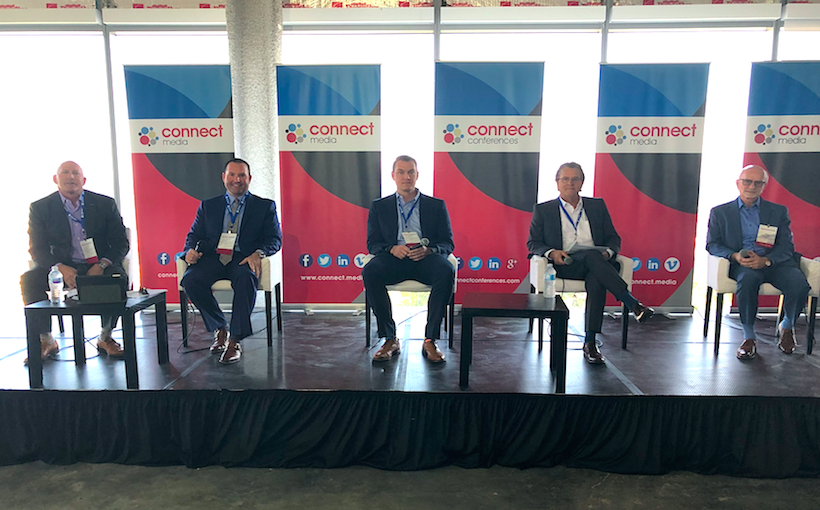

Getting Deals Done Today: Investment, Financing, Leasing
By Dennis Kaiser
Nearly 450 commercial real estate leaders gathered in Irvine on Sept. 25 for Connect Orange County. The event kicked off with tours of Trammell Crow Company’s newest office development, The Boardwalk OC, and concluded with a cocktail reception on the eighth-floor outdoor terrace overlooking the two-acre courtyard. Four panel discussions included a legislative update on key issues impacting CRE, an overview of development activity and project financing, a synopsis of redevelopment efforts across the county and ways industry pros are getting deals done today.
We will take a deeper dive into the panel titled, Getting Deals Done Today: Investment, Financing, Leasing, which was moderated by Cox, Castle, & Nicholson’s David Wensley.
Capital Sources
Wensley pointed out that finding capital is not the problem to closing deals today because there is plenty chasing deals. He noted a recent deal where four to five lenders created a “very competitive” situation. Yet, the “interest rate movement has placed pressure to make choices quickly,” he said.
Marcus & Millichap’s Michael Derk agreed that there’s a “ton of capital in the market.” Though he notes a critical issue to watch is the recent change in tax credits for corporations, which caused yield to increase and placed pressure on interest rates. That caused lenders to “react quickly,” and rates went up while cap rates remained the same. He warns that sellers need to prepare for re-trades from buyers because proceeds at close may not come in as envisioned at the beginning of the process, since the loan timeframes are now longer.
SRS Real Estate Partners’ Rich Walter says there’s a significant amount of education needed up-front now to ensure the borrower understands the lender needs, and to make sure the lender knows the story behind the deal. That may include bringing a lender into the process when they are pitching the listing. “You can’t wait for the buyer to bring financing,” he says.
Wensley says the two biggest challenges he sees in getting a financing deal done are one, sellers and market demand has created “unreasonable timeframes” in which transactions are expected to be consummated today. “There’s a high pressure scramble to get deals done,” he says. Second, he notes, sellers tend to have an inflated view of the value of the asset, and that leaves “no room for error” in the due diligence process. Ultimately, that unrealistic perspective may lead to frustration and sellers starting over with other parties, further delaying a sale.
The refrain that there’s plenty of available capital was echoed by Harbor Associates’ Paul Miszkowicz. Though comparing this cycle to the previous one, he doesn’t see a repeat of 2008-2010 on the horizon, because deals are being underwritten accordingly. That means lenders are taking into account potential factors such as non-recourse, vacancies, free rent, as well as the product and market.
Products and Markets in Demand
Passco Companies’ Gary Goodman, says they remain “bullish on multifamily” properties because the sector has proven to “beat performance expectations” relative to other property types, even in downturns. He says, the market shifts have created “tremendous demand for multifamily across the country.” And that’s resulted in multifamily being “extremely healthy now.” Passco has continued to explore markets outside of California, especially in secondary or tertiary markets, because they’ve proven to be resilient as a result of Nimby or no-development attitudes of many suburban communities, which has helped accelerate rent growth.
SRS’ Walter is pursuing retail assets in need of redevelopment or repositioning as a value-add play. He says, overall the retail sector is now focused on two groups: Millennials and Baby Boomers, since they have cash flow and disposable income. Yet, each have different perspectives and preferences that retailers must know and understand. “We look for established communities now,” he says.
The quest for experiences within a retail setting continues to emerge as a trend, with restaurants and entertainment popular choices for mall owners to add. He noted that getting the right mix and balance of tenants will always be a consideration. Walter says an emerging trend he’s noticed is for more service-oriented tenants, Amazon-resistant tenants and those online retailers looking to establish a physical presence.
Harbor’s Miszkowicz likes value-add investments too, except they are seeking vacant or partially vacant assets in the office sector. “We create specific places near housing,” typically in “slightly off locations,” he says. That means opportunities in suburban locations, despite the lack of glitz and glamor compared to higher profile CBD-type locations because they can produce “more yield” than a location in the Irvine Business Complex, for instance. They may explore options in markets such as the Inland Empire or Aliso Viejo because the airport and Irvine markets are “over-bought” in Miszkowicz’s view.
Marcus & Millichap’s Derk offered that the “darling” property sector of the finance world is multifamily. That is followed by the industrial product type and on a case-by-case basis for office and retail, though the “big box product continues to be a concern,” since “without a credit tenant it will be tough to finance.”
Walter noted that the prevalence and abundance of 1031 exchange buyers is noteworthy in this market cycle, although those types of deals may still require some degree of financing. Having an all-cash buyer in the pool helps make the deal go quicker, he points out, as does looking for issues early and paying attention to NOI so there’s “no slippage at the end.”
Passco’s Goodman says they compete for deals now by taking the interest rate risk off the table for the seller by coming with cash offers. That’s helped them get a “leg up.” He says, “if I can tell the seller we don’t need a Freddie or Fannie loan and we can close in 15 days,” it becomes an advantage. “We missed out on deals, so we learned to be aggressive,” says Goodman.
For comments, questions or concerns, please contact Dennis Kaiser
- ◦Financing
- ◦Development
- ◦Sale/Acquisition


