



California CRE News In Your Inbox.
Sign up for Connect emails to stay informed with CRE stories that are 150 words or less.
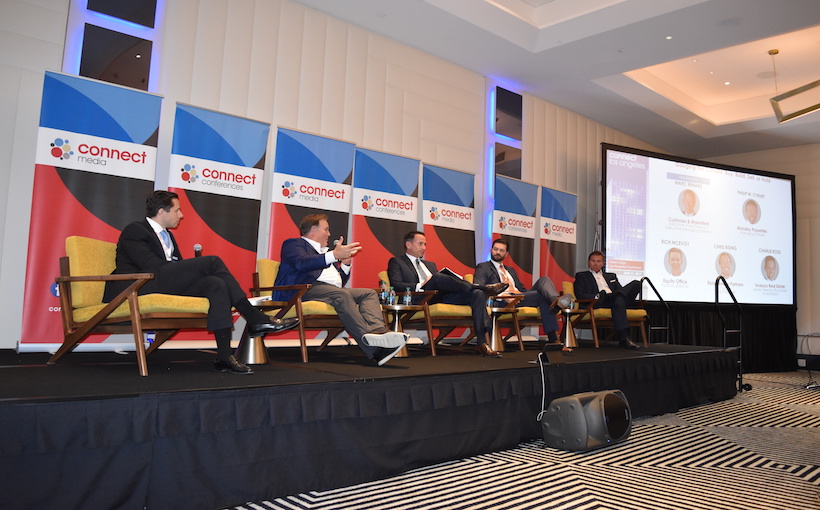

Gauging the Climate: Buy, Build, Sell or Hold
By Dennis Kaiser
The big themes that emerged during Connect Los Angeles’ panel discussion titled, Gauging the Climate: Buy, Build, Sell or Hold were how the climate has shifted, how transit has become a significant driver to deals and why creating work environments that appeal to employees is a top priority.
Cushman & Wakefield’s Marc Renard, who moderated the panel, noted that many of the conversations he has these days with clients involve concerns about what’s wrong rather than what’s right. He says, the climate is clearly in a “recalibration” stage.
Invesco Real Estate’s Charlie Rose agreed that the market has shifted into more of a slowdown stage, and the “wind is not behind our backs like it was two years ago.”
Set against that backdrop, the market is unsure if the peak has been reached or if the run-up will continue for several more years. And the focus for companies has shifted to finding ways to attract and retain the best employees.
Monday Properties’ Phil Cyburt said “labor is everything to our tenants, which makes access to transit key.” Given the overarching changes occurring, the driver today is tenants. Companies are paying close attention to acquiring and retaining their talent.
Los Angeles’ significant investment into transportation infrastructure has made the region the envy of other markets, and plays into a company’s recruitment arsenal too. Interestingly, it also aligns with emerging investment priorities, as capital is hungry for assets that are near transportation hubs.
Cyburt says, having access to those connections are attractive to companies. That’s one reason Monday Properties’ strategy is to buy on the Metro lines.
For some, strategies are shifting away from development to focusing on existing assets that can be acquired at below replacement costs and extract value. Equity Office’s Rich McEvoy says its strategy is based on creating environments employees want to be in that go beyond the bocce ball courts and soft seating. The company seeks to create better spaces or finding more interesting ways to use space that appeal to tenants in the future. The goal in SoCal, McEvoy says, is to replicate a tech company corporate campus you might find in the Silicon Valley.
That’s important because companies are now acutely focused on acquiring and retaining talent. That’s why Equity Office applies an entrepreneurial approach by attacking each property differently. There isn’t one solution that fits all situations since each asset is different, McEvoy says.
The coming Millennial workforce is significantly changing office environments to more full-service, hotel concierge-type of spaces that feature lobby lounges, large exterior amenities or rooftop decks. It is now about offering experiential workspaces that allow for a better work-life balance and makes life easier for employees, as a way to give them their time back while at work. McEvoy says, big businesses are paying attention to that too.
That shift to an employee-focused work environment has even altered the space search process. Rising Realty’s Chris Rising says, the decision making has changed from a CEO-driven process to one that now involves a diverse committee. The goal is to build out space to accommodate people being in the work environment for 12 or more hours. That requires owners to consider how the space will be used, who will come into the office and then provide an overall environment that allows people to be at a building for a longer span of time. Cycling forward, the strategy of creating spaces that allow “creative collisions” to occur is how Rising believes will let them rise above the competition.
Invesco’s Rose says the company’s strategy is to align with partners in the marketplace who live and breathe the daily ebb and flow of a market. That lets them see changes and make a move on an opportunity before the institutional players can. That was the case with its One Santa Fe project in DTLA that now is in the midst of a neighborhood in full revival. That strategy allowed the company to spot an early trend that wasn’t readily apparent when people first began to move into warehouses in the Arts District.
Monday Properties deploys a building-by-building approach, versus a market-by-market one, which allows it to find asset differentiators. Cyburt says that by segmenting amenities to fit the tenant base it helps to set up their ability to increase rents and drive value. To be able to achieve rent increases it requires tenants to get past the emotional aspect of the higher cost. Owners must also “prove it up” by showing the total dollar amount of staying in a new revitalized work environment or relocating. Cyburt says, that can be done by doing comparisons of such factors as productivity improvements, drive time reductions or by showing that the new workspace and amenities has created the right environment their employees want, thus reducing the chance top talent will leave.
For comments, questions or concerns, please contact Dennis Kaiser
- ◦Development


