



Chicago & Midwest CRE News In Your Inbox.
Sign up for Connect emails to stay informed with CRE stories that are 150 words or less.
CRE at the Intersection of Industrial and Retail
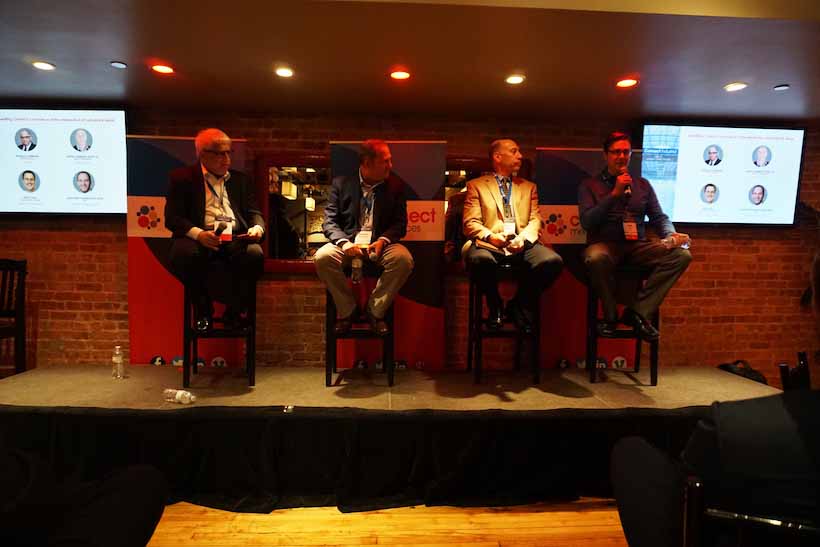
“It is not simply the Amazon-ization of commerce that is causing shifts: shifts in building, shifts in transportation,” said moderator Ronald Leibman of Riker Danzig. “There are huge, almost seismic shifts in transportation,” ranging from shortages of drivers at Christmastime to the deepening of the Port of New York and New Jersey.
At the recent Connect Industrial conference in Chicago, Leibman and his panelists—Geoffrey Kasselman of NKF, Keith Gill of DHL Supply Chain and David Liebman of Merit Partners—made it abundantly clear that the Amazon factor wasn’t the only driver in location decision-making. The one-hour conversation, “Expediting Orders! E-commerce at the Intersection of Industrial & Retail,” covered ground ranging from the technology of next-generation distribution centers, to consumer demand for expedited delivery and attracting, retaining—and retraining—talent.
Kasselman cited labor considerations in two deals he and his team arranged: a 1.1-million-square-foot requirement in the Atlanta area for Asos.com, which employed well over 1,000 area residents; and a considerably smaller one in Cincinnati for DWR, with about 75 employees. “At both ends of the spectrum, it was 97% about labor,” he said.
Liebman provided an example from the office sector that illustrated the same principle. Two blocks from the Connect Industrial site in Chicago’s River North, he handled a leasing assignment for “a billion-dollar food company” that opened a digital analytics and marketing office in the city after two years in Minneapolis, even vacating the Minneapolis site with a couple of years still remaining on the lease.
The Minneapolis sojourn had proved disappointing, he said, because of a dearth of Millennials–i.e. the natural labor-pool constituency for a digital analytics operation–in the local workforce. “Regardless of whether it’s office or industrial, this is a huge, huge consideration,” he said.
That’s the case even when human capital is at a premium. Modern industrial space “has to be able to accommodate automation, mechanization, robotics,” said Gill. “In the shortage of labor in these markets, we have to stay in those markets. And if there are no humans, machines are going to take over.”
And where there are humans available, there needs to be amenities at the facilities to help recruit them. Kasselman described the range of amenities Gill designed into the large-scale Asos project, ranging from gyms to luxury break rooms, and Gill concurred that each and every one of them was necessary.
“Regionally, in Atlanta it’s basketball courts, and in Canada it’s hockey rinks,” said Gill. “You’ve just got to appeal to what’s popular in the area.”
Naturally, the intersection of human capital and computerized operations means that while there may be fewer workers, their skill levels have to be greater. “They need to be coming in with that level of technical knowledge in order to keep up,” Kasselman said.
For comments, questions or concerns, please contact Paul Bubny
- ◦Economy
- ◦Development
