



New York & Tri-State CRE News In Your Inbox.
Sign up for Connect emails to stay informed with CRE stories that are 150 words or less.


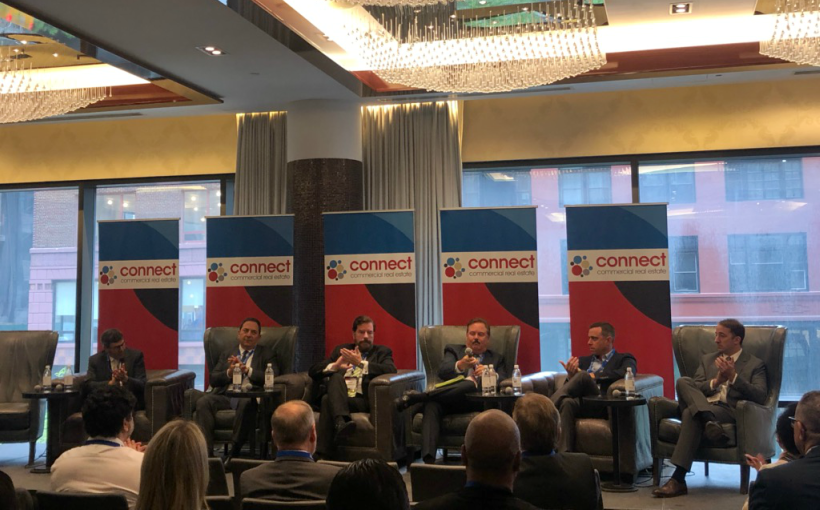
Connect New York: Institutions See Post-Q1 Pickup in Deal Flow
First-quarter investment sales volume was down 11% year over year even as pricing increased by 5.8%, moderator Steve Pumper said in setting the stage for a panel discussion with institutional heavyweights at Tuesday’s Connect New York conference.
Pumper cited volatility in both the stock market and 10-year Treasuries as factors. Additionally, Managing Director Douglas Schwartz of JP Morgan pointed out that Q1 activity was also muted by would-be investors’ nervousness about further interest rate increases by the Federal Reserve.
Similarly, SVP Timothy McGuire of Brookfield Asset Management recalled that Q4 of 2018 meant plenty of deals for the firm’s debt platform, but Q1’s volatility sent investors to the sidelines.
“There was a lot of noise in the system,” said Pumper, executive managing director with Transwestern.
The noise appears to have subsided, as deal velocity began increasing as Q1 gave way to Q2. Whether that deal activity looks like what the market saw four or five years ago, though, is another matter.
Although New York has always been a major market for Invesco Real Estate, ”it does feel as though the best growth is behind us,” said Managing Director Peter Feinberg. That puts the emphasis on current yields.
And even as the Big Apple has always loomed large in the strategy of DWS/RREEF, the firm’s David Hamm noted that by and large the city has underperformed the broader market in recent years. Only Washington, D.C. has been comparable in terms of performance, said Hamm, managing director, transactions.
The post-recession diversification of New York’s economy—an attribute cited repeatedly by Connect New York panelists—has been the highlight of the recovery here, Hamm said. “It’s been a tough market to be rewarded in,” he said.
Performance in key markets leads to the inevitable question about a mature real estate cycle. However, Schwartz doesn’t see it that way. “From my perspective, it doesn’t feel like it’s late in the cycle,” he said.
The one exception to that general feeling, he added, is that it’s now often possible to buy buildings at a great discount to replacement costs. That wasn’t the case a couple of years ago.
Another hallmark of the current market is tight spreads, which Aegon’s Philip McAndrews attributed to institutions’ desire for portfolio diversification via real estate and other alternative asset classes, amid volatility in equities and narrow yields in fixed income. “The alternatives are so du jour right now,” said McAndrews, head of real estate equity.
By asset type, McAndrews noted, multifamily has not consistently ranked as the best performer. In recent years, that distinction has sometimes been claimed by industrial. However, he said, on a long-term basis, apartments have been proven the most durable in terms of risk-adjusted returns.
For comments, questions or concerns, please contact Paul Bubny
- ◦Economy
- ◦Sale/Acquisition
- ◦Sale/Acquisition


