



New York & Tri-State CRE News In Your Inbox.
Sign up for Connect emails to stay informed with CRE stories that are 150 words or less.


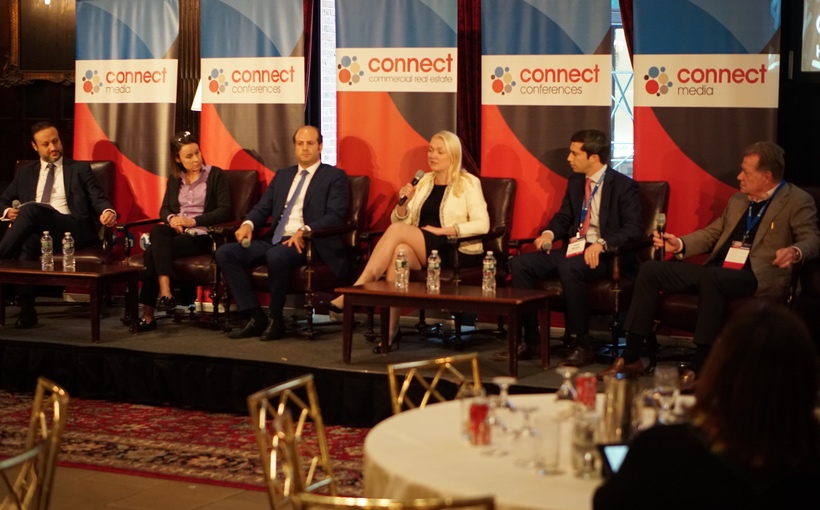

Connect Investment & Finance Experts See the Challenges, Focus on the Opportunities
By Paul Bubny
Eleven years into one of the longest real estate cycles on record, a near-term general slowdown wasn’t a scenario propounded by the experts presenting at Connectional National Investment & Finance 2019, held recently at the Harvard Club in Manhattan. Despite a smattering of headwinds and signs of increasing caution, the tenor of the conversation was mainly about opportunities rather than challenges.
That being said, speakers on the opening ‘Debt Strategies’ panel acknowledged that they’re doing a few things differently at this late state in the cycle, in response to a question from moderator Michael Schneider of Hunt Real Estate Capital.
Pender Capital Lending VP Kristin Rick said her firm has pulled back lately on financing for hospitality and assisted living projects. But all in all, she said, “we’re in a good spot.” At Pacific Western Bank, managing director Mark Silverstein said underwriting has become rooted in current metrics, rather in expectations of pro forma growth.
“When we’re sizing the deal, we’re assuming it’s not going to be better,” he said.
Along similar lines, Thorofare Capital’s Brendan Miller said, “If the sponsor can’t get us comfortable that the business plan can be accomplished in 36 months, it’s probably not for us.”
Schneider asked his panelists what was making them lose sleep, and weighed in with a few concerns of his own. The coming phase-out of Libor as an index was one; a steep rise in interest rates was another.
“Cap rates are low, values are high,” he said. “I worry about any event that could cause rates to increase sharply.”
A couple of days after the Oct. 23 conference, TPG Real Estate Finance Trust closed on a $1.2-billion commercial real estate collateralized loan obligation (CRECLO), underscoring the fact that this securitization method has been in vogue. During Connect National Investment & Finance’s panel discussion comparing CMBS to CRE CLOs, Credit Suisse’s Stefanos Arethas said the CLO format has “a lot of daylight ahead of it.”
By comparison to CMBS, CRE CLOs still represent a small market. CMBS these days is about a $100-billion annual market, compared to $20 billion for CRE CLOs. Basis Investment Group’s Shaunak Tanna called the latter “a post-recession phenomenon.”
It’s also a phenomenon where lessons learned from the 2008 financial crisis have been applied. The version 1.0 of CRE CLOs, said Natixis’ Jerry Tang, was “a kitchen sink of vehicles that should never have gotten triple-A ratings.” Version 2.0, Tang said, has considerably better credit.
The subtitle of the conference’s investment strategies panel was ‘Under Pressure,’ and the discussion, moderated by AFIIA U.S. Investment’s Dino Christforakis, did touch on pressures when it comes to achieving returns, staying relevant in an increasingly tech-centric world and weathering economic headwinds.
“Valuations are certainly on our minds as cap rate compression continues,” said CBRE Global Investors’ Larissa Belova. She added that she expects returns to moderate and to be based increasingly on current income.
Fellow panelist Chris Pfohl of Pyramid Hotel Group cited the competitive threat of Airbnb as a concern, but added, “long-term, we’re bullish.” He noted that the lodging sector is usually the first property sector to feel the effects of an economic slowdown, but said hotels remain strong.
Longer term, said B+E’s Camille Renshaw, “The companies that will be around in three decades are the ones that embrace innovation and technology in their core competencies.” She got general agreement from her fellow panelists that CRE traditionally has been late to the tech and innovation party.
The developers whose conversation closed out the conference each brought a distinctive approach. All, however, saw value in having capital partners.
“We wouldn’t be able to run the business if we didn’t raise joint-venture equity,” said 60 Guilders’ Kevin Chisholm. Although Toll Brothers does its own financing on its single-family developments, the company’s rental projects entail JVs, said the firm’s Frederick Cooper.
With or without partners, development isn’t without its challenges. ”It’s hard to get deals done these days,” said Alchemy Properties’ Joel Breitkopf, citing construction financing as a specific hurdle, particularly for condominiums. Cooper noted that in many Northeast and Mid-Atlantic markets, finding developable land could be tall order.
All three, though, told moderator Charlie Stephens of Cushman & Wakefield that they’re eyeing new opportunities. Breitkopf cited “opportunistic” condos along with rentals, Cooper said Toll Brothers has made forays into single-family rentals and Chisholm said he’s looking to acquire “big office buildings” that are ripe for repositioning. Another area of opportunity for 60 Guilders is student housing, of which New York City has a dearth.
Pictured: The Debt Strategies panel.
For comments, questions or concerns, please contact Paul Bubny
- ◦Financing
- ◦Development
- ◦Sale/Acquisition

