



Chicago & Midwest CRE News In Your Inbox.
Sign up for Connect emails to stay informed with CRE stories that are 150 words or less.


Chicago’s Apartment Market Dynamics: Q&A with Marcus & Millichap’s David Bradley and John Sebree
In common with other state and local jurisdictions around the U.S., Illinois is considering a law that would impose rent control on apartments. Much of the impact of the Illinois law—more properly, a repeal of a 20-year ban on imposing such laws locally—would be felt in Chicago. As John Sebree (pictured above), director of Marcus & Millichap’s National Multi Housing Group, explains, the rent control measure would target affordability in workforce housing but wouldn’t really address it.
The firm has scheduled a webcast for March 20 on the question of rent control in Illinois and elsewhere. To map out the current landscape for multifamily investing in the Chicago region, Connect Media spoke with Sebree and David Bradley (below), regional manager of Marcus & Millichap’s Chicago Downtown office.
Q: Chicago apartment investing is very diverse in terms of product type and neighborhoods. What are some of the common characteristics that investors have across this market?
 David Bradley: In terms of large cities around the country, Chicago is unique. We’re an importer of capital from other parts of the country and the world, and also an exporter of capital. Some people that have owned real estate here for a long time are choosing to move their money outside of the city and into other markets.
In terms of the investors buying in Chicago, I’d put them into three buckets. First is brand-new capital formation: people who have done well in other industries and other businesses and are now looking for some sort of diversification in their portfolios.
We’re also seeing a lot of coastal capital—from the Bay Area, Southern California, parts of the Pacific Northwest, New York. But a lot of that is driven by the yields that are available even in some of the higher-dollar markets like the Gold Coast; they’re more attractive than what’s available in their own backyards.
The third bucket is something we’re seeing even more of than two years ago: the international buyer pool. We’re seeing it come from many different places, including Asia, parts of Europe and South Africa, and it’s not neighborhood-centric at all. It’s across the board.
Q: On the subject of neighborhood-centric, looking at some of the big mixed-use projects that look as though they’ll be moving forward, such as Lincoln Yards, are these demand influencers in any way?
Bradley: Yes, 100%. A lot of buyers that were active following with opportunistic plays after the downturn aren’t finding the same yields now. So they’re pursuing different product types, including adaptive re-use, in the vicinities of these projects.
A lot of the activity is coming from people that are connected and understand some of the things that are going on behind the scenes of these developments. It’s causing a lot of properties that had been overlooked for some time to get picked up.
Q: Condo deconversions are not unique to Chicago, but the area has been an epicenter for these types of investments. Does this trend have runway left?
Bradley: It still has some legs from an economic standpoint. It’s going to make sense as long as the units are less valuable from the standpoint of an owner-user. If there’s a premium they can achieve by selling it to someone who will convert it back to a rental, then yes, there will be continued activity in that space for at least the next one to two years.
That being said, I think the low-hanging fruit has been picked. A lot of condo associations have become aware that this is going on, and as people are becoming more educated, the asking prices are going up, and spreads and yields for new owners are getting compressed. If anything were to quash it in the next year or two, it would be pricing expectations that are not in line with what investors and developers are willing to pay.
Q: What are some of the advantages from an investment standpoint of buying outside the city itself?
Bradley: There are potentially higher yields than in certain submarkets in the city, where yields have really become compressed over the past couple of years. A lot pf people that have moved out of the city and into the suburbs have done so to get away from the tax structure in Cook County. It’s a cost-containment measure, because they have a little more visibility on what they’re going to be paying year in and year out.
Another, more location-dependent factor is transit-oriented developments. The rental rates are lower than they are in the city, and we’ve seen some tenants who have been priced out of apartments into the city, but by moving out into the suburbs, they’re within walking distance of a train station. We’re also seeing Millennials moving out of the city as they get married and have kids, so people are investing long-term based on that trend.
Q: Marcus & Millichap has scheduled a webcast on rent control. What’s the impetus for the webcast?
John Sebree: Our thinking behind the webcast is education, more than anything else. Rent control is something we’re hearing a lot more about in different parts of the country, and the reason is that there’s a lot of pressure on workforce housing and a lot of politicians who are less educated on the subject and view rent control as a solution. We agree that there is an issue that needs to be addressed, but rent control is definitely not the solution. In fact, the majority of economists will tell you that imposing rent control will not address the housing issues for working-class families, and in fact will exacerbate the issues.
 Get Chicago News in 150 Words
For comments, questions or concerns, please contact Paul Bubny
- ◦Economy
- ◦Sale/Acquisition

Apartment buildings for sale
Check out the latest properties available on apartmentbuildings.com
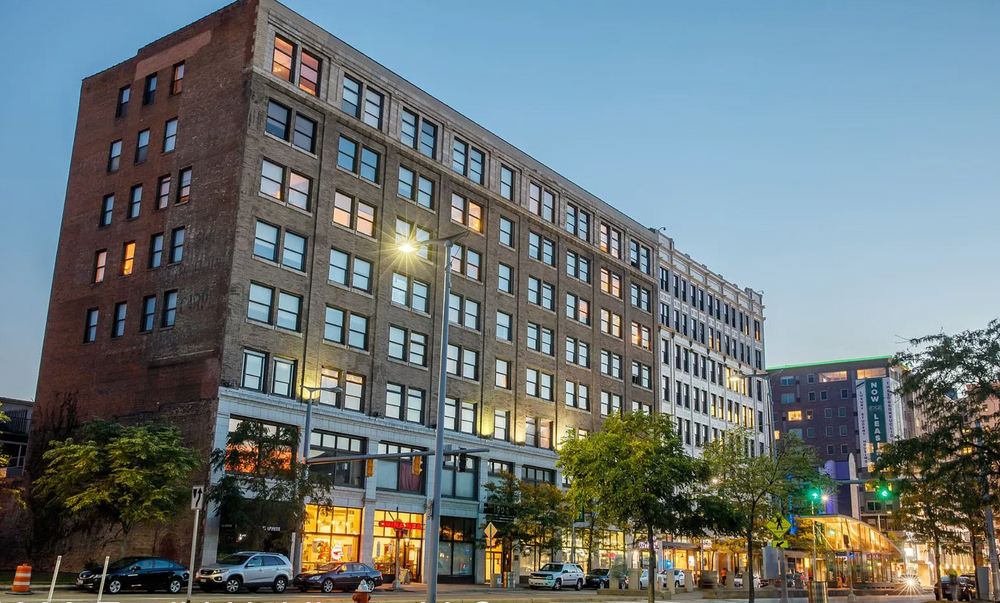
1900 Euclid Ave
Cleveland, OHChicago & Midwest + Apartment Buildings
Learn MoreListing Status: Available Listing Type: Call for offers Price: $19,000,000 No. of Units: 83 Year Built: 1912 Lot Size: 0.70289256198347 Acres Opportunity Zone: No Price per unit: $228,915

